Note: This article does not aim at demonizing the subject of discussion, but to point out what it is and its effects on people.
From the moment of birth, we all go through a process of being trained to become an acceptable individual in society — to be a standard, ‘normal’ member that conforms to the established social norms approved by the general public and other peer groups. This training is known as ‘social conditioning’ and its purpose is to uphold social order and stability, which makes it not only inevitable, but also necessary.
Society does not just exist. Individuals together form a society, which in turn shapes and influences, then further tries to control and dictate the former with peer pressure. In any social group, the majority of people will unconsciously submit their will to the ‘culture’ created by the leadership, executing the culturally accepted standards because they all share the same or similar cultural values. This conformity is the hive mind effect.
Does that mean social conditioning is bad and we should abolish it? No, it is an inevitable, naturally arising process that is necessary as explained, and regarding the second part of the question, quite evidently ‘no’ because it sounds like anarchy and chaos. The problem with the current social conditioning process that we have is—it’s unconscious and highly rigid due to a variety of factors.
The real money-grabbing question here is, “HOW can we modify social conditioning to make it a positive process?”
The culture of a social group is generated by its founder(s) and other top leader(s). This culture is a set of values that define the very identity of the group, which then gives rise to a collective ego and a set of social norms to secure that ego. To preserve their culture, all leading individuals want to direct their group(s)/organization(s) in the way they deem fit, which reflects their personality and core values projected in that culture.
Before diving into how rigid social conditioning is detrimental, let’s first see the reasons why social conditioning arises at all. In essence, it serves the following purposes:
- Uniformity for maintenance of order and stability;
- Easier management and administration for the leadership group;
- Manipulation for personal gains by the higher-ranked.
Imagine you have to lead a group of people. You cannot manage a chaotic bunch that comprises all sorts of individuals with each behaving his own way. In order to manage and lead, you need to unite them all under a set of rules, and this is exactly social conditioning, which translates into more social order and stability.
On a cellular level, let’s take cancer for example. Cancer happens because certain cells become genetically mutated, diverging from the normal cells. We can see that in the same logic, individuals that differ from the rest of a particular group are generally not favored because of the potential disruption.
Beyond the need for manageability, a great many individuals in positions of power also take advantage of social conditioning as a means towards personal gains. Because they want to exploit others, they need a system of conforming and unthinking army that follows orders without questioning what is decreed.
In a society with sclerotic social conditioning, the erasure of personal identity is just a matter of time as that society seeks to filter out members with the same or similar consciousness that fails to see why being different offers anything of value because their consciousness has been (re)structured in a way that is not capable of understanding why a novel perspective makes sense.
Society as a whole is a massive collective entity that consists of one majority group, which represents society itself, and many other minor groups. This majority group will impose its collective identity and ego on every other group by way of implementing social norms.
If you are too distinct, evidently, you will find it extremely difficult to blend in with most people around you because they belong to the shared social identity, so their interests, concerns, and whatever else they feel normal with are naturally within the social norms and common consciousness. This also means, for the most part, most of their struggles will be more relatable to others, and it will be generally easier for them to find sympathizers in difficult times.
Once social conditioning is well-executed, people exist mostly to strengthen the identity of the top leaders. So, the more divergent an individual is, the harder it is for that individual to find alignment with the rest.
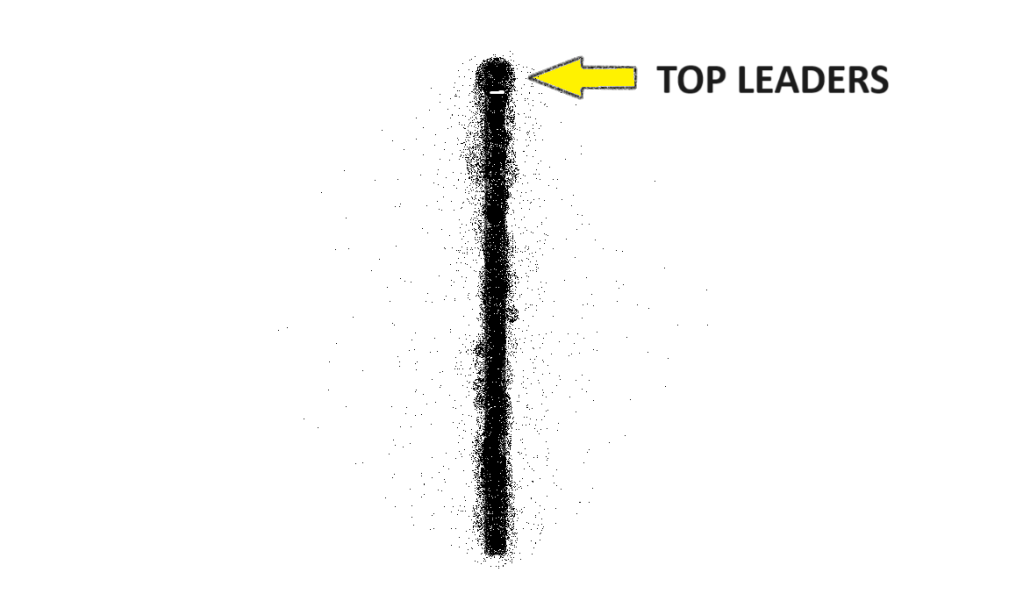
Take a look at the image. “Social identity” is represented by an axis, and individuals by the black dots. At the top are the highest leaders where the concentration is densest. As you can see, the further away from the axis, the population density becomes sparser; the spaced-out dots are individuals with a significant level of divergence. Through this picture, it’s easy to see why different individuals will have a hard time in finding a common ground with the majority.
In every social group or organization, the culture is one of the life-or-death factors because is the heart and soul of any collective entity, the residence of the group’s core values without which it cannot exist due to the lack of stability and consistency caused by an unclear identity.
Social conditioning emerges as a means to uphold and protect the majority’s identity and culture, excluding and eliminating members who fail to fit in as they are viewed as potential threats and dangers to the group’s survival. As a result, they will have to face implicit alienation and discrimination, as well as to accept as normality the fact that it’s a characteristic trait of their existence.
It is understandable to expect tradition and culture should be kept intact and forever unchanged, but that wish goes against the natural law of change. Everything changes – time, people and things. If people want to keep their values alive and lasting, they will have to evolve, or cultural death is inevitable; nobody can contradict the universal laws that brought them into existence in the first place. As such, survival, conclusively, requires change, and ‘change’ essentially implies ‘creativity’.
Creativity, ironically, in contrast to people’s wish of self-preservation, is characterized by change and difference.
It is important to note this: a society will become stagnant and face eventual degradation then destruction without creativity. If anyone studies history, it can be seen that the natural and general evolution of civilizations goes like this: Emergence – Rise – Peak – Stagnation – Fall.
After a civilization has reached its peak, if it is unable to make truly transformative changes, it will die, but its vital force depends on its capability of being creative; the more powerful its creativity is, the more vibrant and flexible it will be in its adaptation, but of course, it’s not without limits. On the one hand, if a society tries to adapt with minimal modifications, it’s no different from an old machine that needs to be well-greased to keep functioning but only gets the bare minimum. On the other hand, if creativity abounds without sufficient direction and regulation, it can lead to confusion and disorder.
The key is to keep a balance between conservatism and creativity with a scientifically methodical selection for the most beneficial values.
Now, the final part of the discussion is, what happens when individuals are suppressed and molded to fit in the rigid norms? To answer this question, imagine this: Naturally you have a normal and functional body like most people, e.g. two arms, two legs, etc., but then let’s say someone chops off one of your limbs because (s)he doesn’t see the natural you as fitting to their eyes. What do you think, then?
It will be horribly painful, crippling, inhumane and psychologically terrorizing, won’t it? That’s my point. The imaginary scenario I have just given is a very simple yet vivid mental experiment for you to understand what it is like to be dismissed by others for being who you naturally are.
However, it does get much trickier and more complex when it comes to social conditioning because this is an intangible process. It is not physical and straightforward for discernment of appropriacy or reasonability. Regardless, the reality is the same in principle. Other people will always expect you to meet their standards, though this is not always directly expressed due to social conduct for politesse. They want to shape you in their image. The result? A hundred people equal a hundred versions of you that you are supposed to be if you want to please every single one.
To be fair, not everyone wants to aggressively reshape you; some in fact are still neutral, and it’s worth keeping in mind that we all influence one another, but we must balance all these influences around us so they can contribute to our productive growth. The problem is, more often than not, society will attempt to suppress your natural growth and reshape you through rigid conditioning wherein the actors include families, schools and other institutions. But then, what matters is open-mindedness, which will break rigidity; if people in these social units are open and understanding enough, they will enable you to grow in a positive direction, and that will demonstrate the flexibility needed to make social conditioning truly a societal building process, not a debilitating one.
One-size-fits-all social conditioning can bring about various negative psychological effects in many individuals, which will affect their mental well-being because, with their natural way of being, they will feel unwelcome, excluded, and unappreciated.
Different groups harbor different values, and to protect these values when recruiting new members, it is only logical that there must be selection and regulations.
We all need a stable and functional society, which is why social conditioning is a must; it keeps society in check by making sure people do not go around doing whatever they want that can seriously affect societal wellness. Things have to be ordered and secure. Yet, it needs to be flexible enough to allow different individuals not only to conform, but also to develop naturally to their full potential and contribute their values to societal prosperity.
In order to achieve that flexibility, it requires much patience, understanding from all of us to better manage relationships, and dedicated research as a collective effort to produce the best outcomes possible for every member of our society.
Social conditioning, after all, is an indispensable part of any society, but it should be individually adaptive. A personalized experience instead of one-size-fits-all molds goes beyond keeping our society stable and functional, it adds harmony to our living space where we can co-exist healthily and conflicts can be resolved based on a universal code of conduct upon which we can all agree.
 The Way of Balance
Leave a comment