When the word “philosophy” is thrown on the table, there is a common stigma about it in society that it is an impractical, unrealistic, irrelevant and far-fetched stuff. And so philosophical people are usually faced with a dismissive attitude from the common public and struggle to lead a normal life like the rest because of their own difference in mindset.
Contrary to popular beliefs, philosophy is not a thing descended from the sky nor is it irrelevant. It’s just a bit difficult to see its origination and how it is applicable to everyday life.
True philosophers are not common, as they generally belong to the minority compared to the remaining part of the whole population. Not everyone is a philosopher, but most people do exhibit some natural philosophicality to at least a certain extent, though insignificant as it may be. It is when we think thoroughly about a problem, a subject matter, a situation, etc. in order to make the best possible decision.
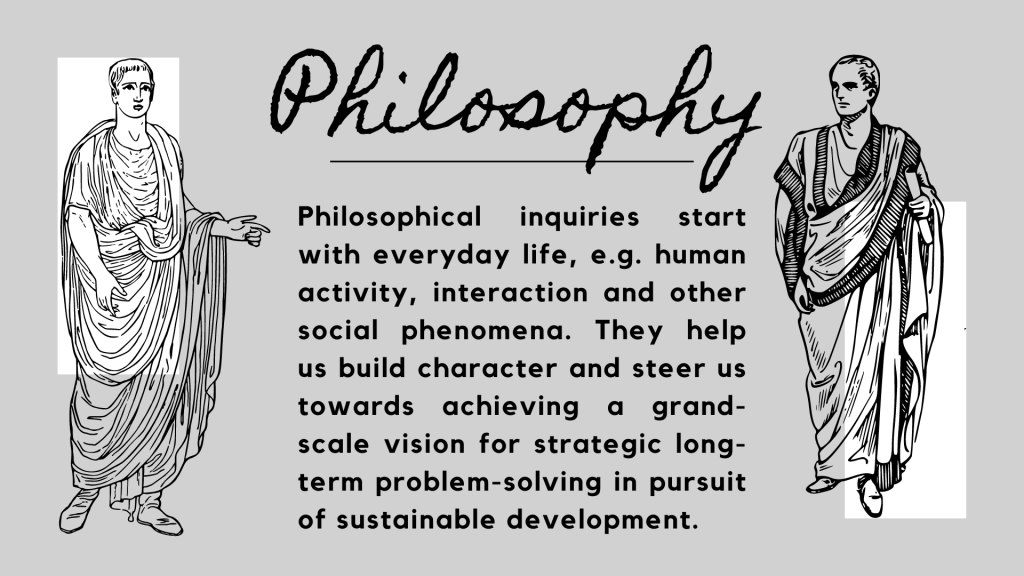
To contemplate is to practice philosophy, for contemplation itself is a philosophical act by nature. Though philosophy can extend beyond the human scope such as inquiring about the natural world, from which any knowledge acquired will eventually come around in service of helping to solve human problems. However, philosophy first and foremost need not be something so far off, as it derives from daily life matters, such as routine activities, people’s interactions and other social phenomena.
What is done in philosophy is not taking things for granted; the single most fundamental and significant question is “why”, which leads us to knowledge and wisdom. It is all about why you do this or why I do that, or why something happens the way it is, etc. Such inquisitions come as being obvious to common people, that there is no need to ask such things, yet those are the very inquiries that drive you towards the discovery of the nature of things.
“Understanding the nature of things? What for?” One may ask, but of course if philosophy were totally useless, it would not have survived the test of time and thus would not be still around today, though it has certainly decreased in popularity.
Philosophy essentially teaches us how to think, how to use our mind efficiently and productively to attain knowledge, which is then applied to solve our problems. Its practice helps us build a distinctive yet powerful mindset and a right mentality/attitude in order to manage situations flexibly with a broader vision. In other words, it upgrades who we are if well-practiced.
To engage in philosophy is to search for the big picture, which brings about vision. If pure/theoretical philosophy is simply concerned with the acquisition of knowledge, then applied/practical philosophy, via knowledge attained from seeing the big picture, is about finding ways to solve problems in the long term, aiming at radically eradicating them, rather than getting stuck in the vicious cycle of dealing with the same short-term problems that keep reoccurring because they are merely the branches and not the roots of what needs resolving.
Besides, both the theoretical and applied aspects of philosophy naturally go hand in hand because without application, there would be nothing to prove the authenticity and effectiveness of the theoretical dwellings and discoveries.
Unlike what people commonly think, “philosophers” who only spend thousands of hours in a room thinking about things so they can come up with new ideas and theories will, one way or another, be flawed about what they have figured out, which they would have a hard time explaining if questioned in detail, because they lack the substantive connection with reality and the direct/hands-on/practical experiences in the real world that can help fact-check and test out their ideas and theories, meaning there is not the factor of reality to back them up in their proposed ideas.
On the contrary, those with a solid knowledge base who can explicate matters reasonably, even if inquired in-depth about his propositions and presentations, are the ones that have dwelled on both the theoretical and the empirical/experimental planes, meaning they do not solely philosophize and theorize, they immerse themselves in the experiences that the world has to offer as well – doing things, going places and trying new stuff – which can help them better reflect, revise and refine their own ideology.
As you might have heard it somewhere, the general idea is: The truth is always logical, yet a logical human construct does not necessarily align with the truth.
Therefore, I propose a principle by which all philosophers should abide (and everyone else should, too): Regardless of how brilliant your ideas are, always give yourself a reality check on a regular basis by delving into actual experiences, i.e. going out more, doing things more, so you may discover the faults in your ideas. No matter how complex you think your mind is, it would never be more so than the very universe that has always preceded you, because if the latter were as much or any less complex than the former, we would not be constantly doing our best to acquire knowledge of it.
In short, the only way to become the best at something is to live it – make it an inseparable part of your life. Render your existence the embodiment of the very philosophy that you advocate, not merely stopping at its conception or incomplete testing.
Philosophy was born out of pure human curiosity, which turned into our thirst for knowledge and quest for truth. In the end, wisdom is the by-product, the culmination of our understanding built over time, which ultimately becomes our means to craft long-term solutions for our problems, and that is how you practically put philosophy to use in the daily life context, because, if you care about the greater good, you would want to tackle your issues with a vision to implement lasting solutions, not only to prevent them from happening again, but also to aid in creating a sustainable development.
For example, within a society, the law, apart from being a political power tool of those on top, is promulgated to ensure social order, which is to prevent civilians from committing immoral acts that can inflict harm on others and society as a whole. Thus, when an individual carries out a felony, if the existing legal system is insufficient to effect justice and deterrence for behavioral correction, one understandable idea is that a new stricter law which is more punitive can be passed and enacted in order to ensure such cases, ideally speaking, will not recur – which is obviously wishful but nevertheless does increase the likelihood of lowering crime rates. However, those hard measures tend to flop in the long run because the real issue lies with the people’s level of awareness; only an effective education can truly mend the problem sustainably.
Ultimately, philosophy is not simply random mind-wandering and asking big questions; it serves problem-solving as well. Practically, much of it starts from everyday life matters about which the questions are to understand things better (knowledge and identifying problems) and how we can improve on what we have had (crafting solutions). It is a tool, a methodology, a means to our ends and a way of life which can effectuate lasting beneficial impacts on our character development in that we truly learn how to become a decent human being.
 The Way of Balance
Leave a comment